Bible Prophecy Year
of 360 Days

What About Other Calendars?
***Click here for automated 360-days Calendar Converter***
|


The 360-day prophetic calendar works in unison with, and gives meaning to, the ancient Egyptian, Assyrian, Babylonian, Persian, Hindu, Zoroastrian, Mayan, Chinese, Julian (Roman), Islamic, Gregorian, and Jewish calendars since all of these were based upon the expert observations of the sun and moon. However, all of these calendars come short in accuracy, usability, and meaning. But the bible fills in where these come short. The bible fully reveals the rhyme and the reason of how the precise cycles of the years and months work. The bible contains the special revelation necessary to know the workings of this perfect calendar-clock.
What about the lunar calendar used by Moses,
which is still used by modern Israel today?The calendar used by Moses at the time of the Exodus out of Egypt (1446 BC, Ex. 12:2) is essentially the same as that one used today in modern Israel: It was a luni-solar calendar. Nevertheless, a careful study of the chronological material from the books of Moses shows that his luni-solar calendar was synchronized with the 360-day calendar.2 (We will examine this later). Moses was very knowledgeable about both the luni-solar calendar and the 360-day calendar since he was "trained in all the wisdom of the Egyptians," (Acts 7:22). The Egyptians used at least three calendars: The 360-day calendar, a luni-solar calendar, and one kept in synchronization with the stars.
However, although there are many similarities between the calendars of Moses and the Egyptians, yet there are significant differences as well. For instance, the 360-day year of the Egyptians was adjusted to the actual 365-day solar year by adding 5 special days at the end of every 360-day period; (12 months of 30 days, plus 5). However, it is evident from the books of Moses (and later, the prophetic writings) that the 360-day calendar of the prophets was adjusted by adding a leap month of 30-days every six years, rather than the Egyptian method of 5 days at each years' end. (The insertion of the 30-day leap-month at regular six-year cycles was also the method used in the ancient Zoroastrian calendar.) Another distinction between Moses and the Egyptians is that Egypt had three seasons to their year whereas Moses held to four, (Gen. 8:22).
What is a "luni-solar" calendar?
In the Jewish luni-solar calendar, the days of the month are set to the phases of the moon, while the number of months are ordered by the length of the solar year. This means that there are 12 months in what is called a "normal" year, but after every 2 or 3 years an extra '12th month' is inserted, to make 13 months in that "special" year. Thus they have either 354 or 384 days in their luni-solar year (plus or minus one day). As said, the 360-day prophetic calendar is not the same as the luni-solar calendar. However, they are similar in this important respect: Both calendars adjust to the solar year by adding a thirteenth month at regular intervals.
|
Hebrew
and 360 Calendars Compared (Note: the bible uses both) |
|
| Hebrew luni-solar calendar | 360-day calendar of prophets |
| 354 days in non-leap month year of 12 months | 360 days in non-leap month year of 12 months |
| 384 days in a leap-month year of 13 months | 390 days in a leap-month year of 13 months |
The leap month (13th month) of the 360-day calendar:
As mentioned earlier, scholars have long recognized the 360-day year in the prophetic writings of the bible.3 And some have pondered the meaning of the extra month in the 3½-year period in the book of Daniel, calculated as 1290 days, (Dan. 12:11), rather then the 1260 days of Revelation 11:3 and 12:6. As we shall see, this extra 30 days (one month) is simply a leap month inserted.
12 months x 3½-years (of 360 days) = 42 months, (Rev. 11:2) 42 months x 30 days = 1260 days, (Rev. 11:3) 1260 days + 30 more days = 1290 days, (Dan. 12:11) The well-known '3½-years' is simply half of a full seven-year period, Dan. 9:27 |
Next, we look at the brilliant way the 360 Calendar is adjusted to the 365.25 solar year; after this we will progress in accuracy until we reach perfection. You will be lead 'step by step' in our study so as to minimize complexity.
To "Step ONE" up the accuracy scale.

 Click
images to enlarge.
Click
images to enlarge.
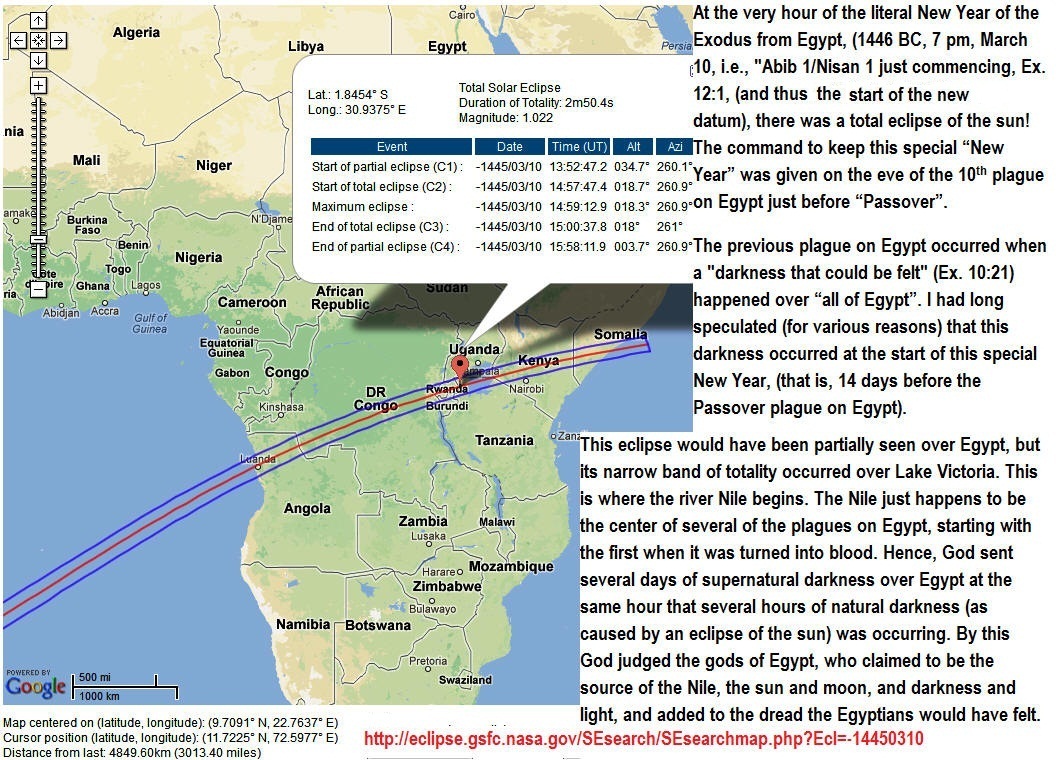
I discovered the above eclipse while working on the below automated calendar. Interestingly, 3.5 years earlier another total eclipse occurred in the same area. (See, Rev. 12.)
360-days Automated Calendar Converter
Or, view supplements:
"The 360 calendar compared
with other calendars."
Why
"360-days," and not some other number?
What About the Solar and Lunar Calendars,
---the Other Two Ways for Measuring the Length of a Year?
The 360-day Prophetic Calendar
is the most simple,1 accurate,
and meaningful of all calendars!
Footnotes:
1 The prophetic calendar would have been simple for ancient peoples to use, especially Israelites; (that is, had they understood it in full as revealed in these documents). It would have been easy for them to use because, firstly, the Israelites were (and are) already familiar with this method of inserting regular leap-months into their calendar (rather than leap-days); and secondly, because the calendar was based upon the simple integer '6' (or '60'). (Example, 360 days = 6 x 60). 'Sixty' was the base-number for commerce (weights and measures) in the ancient world and therefore was easily comprehended by them just as 'ten' is the base-number used by us today, (as in the metric system). {Note: The calendar is "simple to use" for studying time over a 100,000-year span. After that, it becomes slightly more involved.}
2 In the account of Noah's flood, a 360-day year is detected by the usage of a uniform 30-day month. For instance, from the start of the flood rains, until when the ark rested on Mount Ararat, there are an even "150 days" (30 x 5); and this is said to span from the "seventeenth day of the second month" until "the seventeenth day of the seventh month." (Gen. 7:11, 8:3, 4). There are many other examples in the books of Moses, although not as apparent. (See next note for more!)
3 In the prophetic writings, the books of Ezekiel and Daniel strongly infer the 360-day year. It is also inferred to in the book of Ester (1:4). All three of these books are post exilic, that is, written (during) or after the exile to Babylon. It is therefore noteworthy that the Babylonians also used a 360-day calendar system. When we come to the New Testament, we see the 360-day year unmistakably used in the book of Revelation (11:2, 3, 12:6). These things will be detailed later.
A Few Technical Notes:
1. New-years day of Nisan (Abib) 1st (morning) of the 360 calendar landed on March 10, 1446 BC (Gregorian calendar, but which was March 22 Julian). (March 10th on the conventional Jewish calendar that year was about Adar 12.) The Julian day # is 1193352. (That day, therefore, symbolized as AD 1 as explained later.)
2. The 4000-year cycles began in 4006 BC at the Creation and again when they entered Egypt in 1446 BC. (Nisan 1 on the 360 calendar in 4006 BC falls on, or about, the spring equinox, March 21 Gregorian, which is April 22 Julian, which happens to be Nisan 1 on the regular Jewish calendar {as well as the 360 calendar}, which makes it a new moon! {Julian #258342.} The new moon, the spring equinox, and the start of the 360 calendar are therefore perfectly aligned with this Creation date to signal 'a new beginning'. However, it is my personal view that this date is merely symbolic for the Creation, and that the actual Creation date may be something else.)
Note that both Creation (4006 BC) and the Exodus (1446 BC, see note #1) starting points for the "New Year datum" run along the same 40-year cycles only if the creation is set back one month, which would be the case if the first cycle of 4000 years to Christ in 6 BC is merely part of longer cycles that really end with the birth of Christ, as from March, 13,824,000,006 BC as from the first of the largest cycle of the 4000-year calendar. Thus, before Christ Nisan 1st landed on the same day. Afterward, it can be one-month ahead of the other --- basically forever. If the 4000-year cycle is just calculated as from the creation around 4006 BC (which is in accord, more or less, with a literal biblical chronology), or does it go all the way back to the 13,824 millionth cycle, as from March, 13,824,000,006 BC? One makes Nisan 1, 6 BC (on the 360 calendar) to occur on March 21 (with the largest cycle), the other on February 19 (as from both 4006 BC {Creation} and 1446 BC {Exodus}).The first 4000-year cycle ends at the birth of Jesus Christ in 6 BC, Nisan 1 (as reckoned using 360 calendar), (Julian #1719312, March 21 Gregorian, 23rd Julian). There are 64 generations/cycles of 40 years that pass between the Creation and the Exodus, and once again, 64 is a square-root figure, that is, 8 x 8, (or 8 x 8 x 8 x 5 years = 2560 years). Fittingly, the number "eight" in the bible symbolizes "a new beginning", with 2560 years being about how many days there are in a seven-year period, hence memorializing the Creation that took place in "seven days" --- a year for each day.
Observe that an overlap of one month (30 days), therefore, is always possible.
The creation date is not based upon biblical chronology, although it is certainly in the right ballpark. The creation date of 4006 BC is mainly based upon the deduction that a calendar from creation should both weave into the time of the exodus and the birth of Christ, and this one does both exceedingly well. However, the exodus date is the only calendar date that is clearly established by the bible itself. The creation date is only inferred, although strongly so. For more about this, and why the exodus date, see, "What Year are We in According to the 360 Calendar?"
Concerning the 3840-year cycles, I have come to favor the 4000-year cycles for its simplicity over the 3840-cycles, and simplicity is important for a calendar. Thus, 40 and 4000 and 100,000-year cycles. (Note: the 100,000 cycle is the rounding off of the more accurate "96000-year" cycles.) Beyond that I may have gone too far. I may yet put all other information on this website in archive. I am not as convinced of the 3840 cycles as I once was. It works just like I said, but it lacks simplicity, something I underestimated for significance. Also, when the calendar gets into cycles that run into the trillions of years, some of the symmetry exhibited might largely be due to the quirks of numbers. Numbers can do strange things by their very nature! See, "What Year are We in According to the 360 Calendar?"
3. You may find it interesting that the great tsunami that killed 300,000 on Dec. 26, 2004 was 1,260,000 days (Rev. 12) from Nisan 14 (360-calendar) of the Passover of the Exodus, and eve of the 10th plague upon Egypt. Click here for more on that. (This third note has been adjusted by 30 days since it was written. However, the meaning is still the same, just a little longer to explain. The symbolic day-year for the actual day of the tsunami is the reason why, and also see the above note.)
"Step ONE" up the accuracy scale
========
What Year are We in According to the 360 Calendar?
Or, view suggested supplements:
"The 360 calendar compared
with other calendars."
Why
"360-days," and not some other number?